
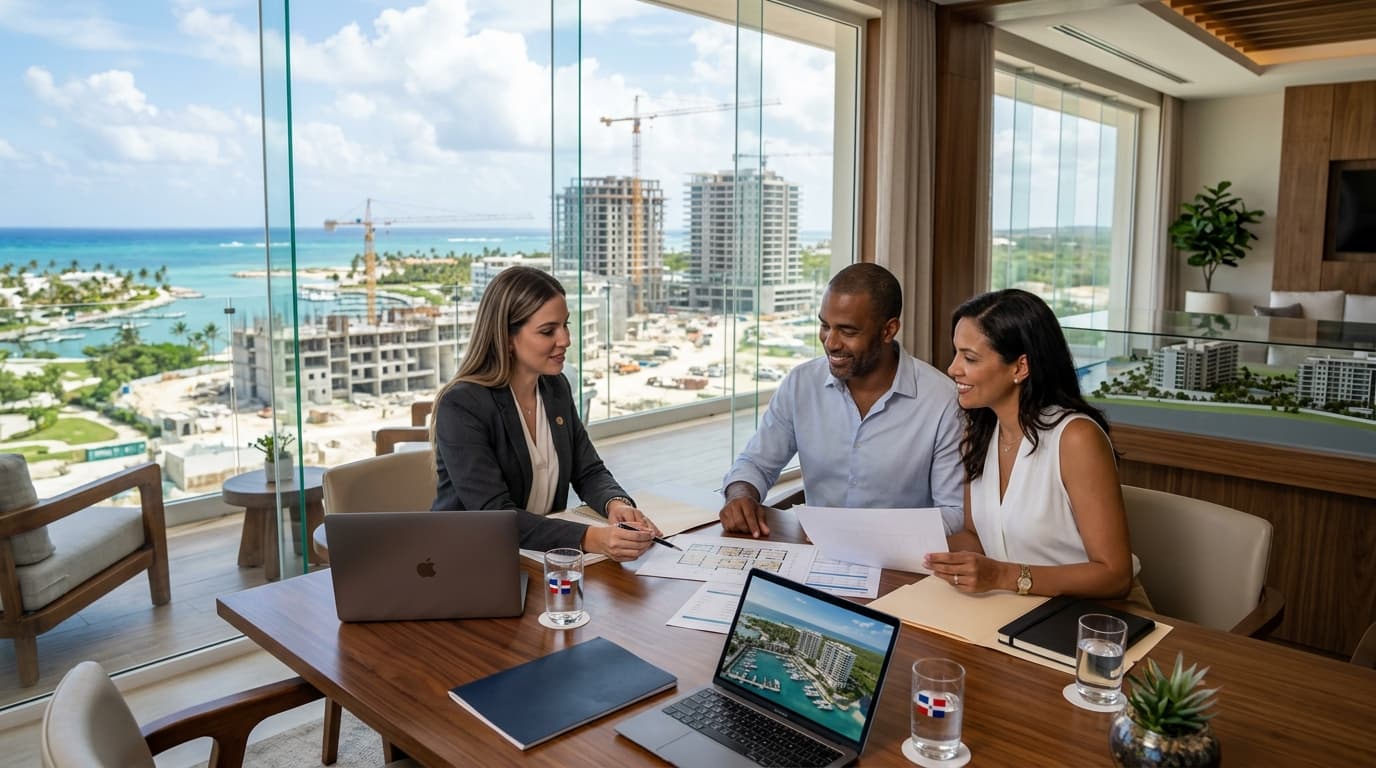
Financing Pre-Construction After Cash Payments: A Guide
By the UpHoming Research Team ·
Discover how to switch from cash to a loan for international pre-construction property. Our deep dive covers specific lenders, rates, and requirements for foreign buyers.
Financing Pre-Construction After Cash Payments: A Guide
You signed the contract, paid the reservation fee, and have been diligently keeping up with monthly cash installments for the last two years. Now, as the building rises in Cap Cana or Las Terrenas and the delivery date approaches, the reality of that final, large balloon payment is setting in.
Many investors realize mid-construction that they would prefer to keep their liquidity rather than tie it all up in bricks and mortar. Perhaps the global market shifted, or maybe you simply found another high-yield opportunity where that cash could work harder. Whatever the reason, the central question remains: Can I switch from a cash payment plan to a bank loan after the project has already started?
The short answer is yes. However, transitioning from a "cash buyer" status to a "financed buyer" involves a specific set of maneuvers, legal amendments, and strict timelines. This guide provides a comprehensive roadmap for the "cash-to-loan" switch, filling the technical gaps that generic real estate blogs often ignore.
Yes, You Can Switch From Cash to a Loan: The Bottom Line
It is a standard and viable strategy to secure financing for an international pre-construction property after making initial payments in cash. In professional real estate circles, this is often referred to as a "mid-project financing switch" or "leveraging the delivery."
Success in this transition depends on three critical factors:
- Timing: You must initiate the bank process 6 to 9 months before the building's official delivery (entrega).
- Contractual Flexibility: Your original "Promesa de Compra-Venta" (Purchase and Sale Agreement) must allow for—or be amended to allow for—third-party bank financing.
- Lender Appetite: You must align with a lender that specializes in non-resident loans and recognizes the specific developer you are working with.
In markets like the Dominican Republic, banks are highly accustomed to this. They view your initial cash payments not just as "spent money," but as your equity stake in the deal, which makes you a lower-risk borrower in their eyes.
The Lender Landscape: Who Actually Offers 'Cash-to-Loan' Financing?
Finding a bank that understands the nuances of a foreign investor's income is the most significant hurdle. You cannot simply walk into any branch; you need the "International Private Banking" or "Foreign National" division.
Spotlight on the Dominican Republic: A Case Study
The Dominican Republic has the most robust framework for this switch in the Caribbean. Based on our decade of experience managing closings in Punta Cana, these are the primary institutions to consider:
- Scotiabank República Dominicana: Often the first choice for Canadians and Americans. They have a streamlined process for verifying North American credit scores (FICO) and offer USD-denominated mortgages, which eliminates currency exchange risk.
- Banco Popular Dominicano: The largest local bank. They are deeply integrated with most major developers. If your project is under a Fideicomiso (Trust) managed by Popular, the approval process for a mid-way loan is significantly faster.
- Banreservas: The government-owned bank. They often offer competitive rates for tourism-related properties through their "Prosperar" programs, though their documentation requirements can be more stringent for non-residents.
Specialized Lenders & Mortgage Brokers
In many cases, working directly with a bank can be a bureaucratic nightmare for a non-resident. This is where specialized mortgage brokers come in. Unlike in the US or Canada, a broker in the DR or Mexico often has "inside tracks" to specific loan officers who handle only foreign portfolios. They can help you navigate the "Cash-to-Loan" switch by presenting your paid-in-cash equity as a solidified down payment.
Beyond the DR: Finding Lenders in Other Markets
- Mexico (Riviera Maya): Look for Intercam or Moxi, which specialize in loans for foreigners. Most Mexican banks (like BBVA or Santander) are hesitant to lend to non-residents unless they have a temporary residency FM3 visa.
- Panama: Known as the "Hub of the Americas," Panamanian banks like Banco General are very open to international financing, provided the property is in a high-demand urban or tourism zone.
- Developer-Affiliated Financing: Some developers offer their own "short-term" financing (3–5 years). While easier to get, the interest rates are usually 2-3% higher than a bank loan.
Decoding the Numbers: Typical Rates, LTVs, and Terms for Foreign Buyers
To manage your expectations, you must understand that financing abroad is more expensive than "home" rates. Lenders view international loans as higher risk because they cannot easily garnish wages in another country if you default.
As of 2024-2025, here is what the financial landscape looks like for a foreign investor switching to a loan:
| Feature | Typical Range (USD Loans) | Notes |
|---|---|---|
| Interest Rate | 7.5% – 9.5% | Fixed for 1–5 years, then variable. |
| Loan-To-Value (LTV) | 50% – 70% | Based on the current appraisal, not the purchase price. |
| Loan Term | 15 – 25 Years | Age limits often apply (Loan term + Age < 75). |
| Origination Fee | 1% – 2% | Paid at the time of closing. |
| Appraisal Cost | $300 – $700 | Performed by a bank-certified appraiser. |
The Power of the "Current Appraisal"
In our experience, one of the biggest advantages of the cash-to-loan switch is capital appreciation. If you bought a condo for $200,000 two years ago and it is now appraised at $250,000 upon completion, the bank bases the LTV on the $250,000. This means your initial cash payments might cover 40% of the new value, allowing you to finance the remaining 60% with very little additional cash out of pocket at closing.
The Eligibility Checklist: Are You a Candidate for a Mid-Project Loan?
Lenders use a "Global Solvency" approach for foreign nationals. They aren't just looking at the property; they are looking at your entire financial life back home.
1. The Credit Score Requirement
For US and Canadian citizens, banks like Scotiabank will pull your international credit report. Generally, a FICO score of 700+ is required. If you are from a country without a standardized credit reporting system, you will likely need to provide "Credit Reference Letters" from your primary banks.
2. Income Verification (The Paper Trail)
This is where most investors fail. You must prove you can afford the mortgage in addition to your current debts at home.
- W2 Employees: Last 2 years of Tax Returns and last 3 pay stubs.
- Self-Employed: Last 2 years of audited financial statements or tax returns, plus a letter from a CPA.
- Bank Statements: Usually the last 6 months of your primary personal and business accounts.
3. Essential Documentation for Foreign Buyers
- Passport & Secondary ID: Must be valid for at least 6 months beyond the loan application date.
- The Purchase Agreement: The original signed contract with the developer.
- Proof of Payments: A certified statement from the developer showing every dollar you have paid in cash so far.
- Developer’s Licenses: The bank will verify that the project has its Confotur (tax incentive) certifications and environmental permits in order.
Your Step-by-Step Guide to Switching from Cash to a Loan
If you are currently in a cash payment plan and want to pivot, follow this exact timeline to avoid a breach of contract with the developer.
Step 1: The Internal Audit (10-12 Months Before Delivery)
Review your "Promesa de Compra-Venta." Look for a clause regarding "Forma de Pago" (Payment Method). If it says "100% Cash," you need to notify the developer's legal department that you intend to seek bank financing for the final installment.
- Pro Tip: Most developers are happy to accommodate this because they get paid the full balance by the bank upon delivery, rather than waiting for your final wire transfer.
Step 2: The Pre-Approval Phase (8 Months Before Delivery)
Do not wait for the building to be finished. Start the pre-approval process with at least two different banks. This gives you leverage and a "Plan B." At this stage, the bank will give you a "Letter of Intent," which you can show the developer to prove you are a serious buyer.
Step 3: Engaging a Local Expert (7 Months Before Delivery)
If you aren't fluent in the local legal system, hire a real estate attorney. They will handle the "Minuta" (the legal document that coordinates the bank's lien with the developer's title transfer). In the DR, this is crucial for projects under Ley 189-11, where the trust (Fiduciaria) must approve the bank's involvement.
Step 4: The Formal Application & Appraisal (4-5 Months Before Delivery)
Once the building is roughly 90% complete, the bank will send an appraiser. They need to see a "finished" product to justify the loan amount. This is when you submit your final, updated bank statements and tax returns.
Step 5: Coordination & Closing (1 Month Before Delivery)
The bank, the developer, and the notary will coordinate a closing date. The bank will wire the remaining balance (e.g., 50% or 60%) directly to the developer. You will sign the mortgage deed, and the title will be issued in your name with a "lien" (hipoteca) in favor of the bank.
Beyond the Dominican Republic: Applying This Strategy in Other Hotspots
While the DR is our primary expertise, the "Cash-to-Loan" strategy is gaining traction in other Latin American markets.
Mexico's Riviera Maya
In Mexico, the process is slightly different due to the Fideicomiso (Bank Trust) required for foreigners buying in the "Restricted Zone" (near the coast). When you switch to a loan, the bank providing the mortgage often becomes the trustee of your Fideicomiso.
- Key Difference: Closing costs in Mexico are higher (5-7% of property value), so ensure your loan amount covers these or that you have extra cash on hand.
Panama
Panama’s economy is fully dollarized, which simplifies the financing process for US investors. The country has a very high "Banking Privacy" standard, but they are extremely strict on AML (Anti-Money Laundering). If you are switching from cash to a loan, you must provide a very clear "Source of Funds" for the cash you already paid.
Costa Rica
Financing for non-residents in Costa Rica has traditionally been difficult, leading most to use developer financing. However, private equity lenders and some local banks like BAC Credomatic are opening up to the "mid-project switch" for high-net-worth individuals.
Common Pitfalls to Avoid
Even with a perfect credit score, several "hidden" issues can derail your financing:
- Developer Delays: If the developer is 6 months behind on construction, your bank's "Pre-Approval" might expire. Always ask for a 120-day extension on your mortgage commitment.
- The "Tax Value" vs. "Market Value" Gap: In some countries, the price on the contract is lower than the actual price paid (to save on taxes). Banks will only lend based on the lower of the two values. Always ensure your contract reflects the real purchase price if you plan to finance.
- Life Insurance Requirements: Most Caribbean and Latin American banks require you to take out a "Life Insurance" policy that names the bank as the beneficiary for the loan amount. This can be expensive or difficult to get if you have pre-existing health conditions.
Strategic Conclusion: Securing Your Investment
The "cash-to-loan" switch is not a sign of financial weakness; it is a sophisticated move for capital preservation. By transitioning to a mortgage mid-construction, you effectively "buy back" your liquidity, allowing you to diversify your portfolio or protect your cash reserves.
The key to a successful transition is proactive synchronization. You must align the developer's construction timeline with the bank's bureaucratic timeline. In our experience, investors who start this process 8 months before delivery enjoy a seamless closing, while those who wait until the "keys are ready" often face stressful delays and potential late-payment penalties from the developer.
If you are currently paying cash for a pre-construction unit and want to explore your financing options, the time to act is now. Ensure your documentation is "bank-ready" and that your legal team is prepared to amend your purchase agreement to welcome a lending partner into the deal.
Keep reading

Santiago to Puerto Plata in 23 Minutes: What a $538 Million Highway Means for North Coast Property Values
July 7, 2026

3.7 Million Visitors, $13 Billion in Bank Commitments: What the Dominican Republic's Record Q1 2026 Means for Pre-Construction Buyers
July 1, 2026
On the DR's North Coast, a Beach Condo Pays You Back 6–10% a Year — and Sells in Half the Time of a Villa
June 23, 2026